
Player Development
Why Choose JrCaddie for Your Junior Golfer

Most kids' golf products fall into one of two categories.
There's the scaled-down adult stuff — smaller clubs, smaller bags, and yardage books built for a 45-year-old's brain, just handed to a 10-year-old.
And then there's the gimmicky stuff — all novelty and no substance: fun for about a week, but it doesn't make anyone a better golfer.
JrCaddie is neither.
Built for the Junior Game
A junior golfer's needs aren't the same as a scratch golfer's needs.
Their distances change every few months as they learn and grow.
In most rounds, their biggest obstacle isn't club selection — it's what happens in their head after a bad shot.
And they're far more likely to stick with a habit that feels like a game than with one that feels like homework.
Every part of JrCaddie is built around that — accommodating your junior where they're at.
The Yardage Book: Real Course Data, But Kid-Friendly
Each hole includes a fairway layout with calibrated distances, elevation profiles, and green details — the same information a caddie would give a tour player, translated into something a junior can read and use standing on the tee without 20 years of built-in knowledge.
No guessing. No "I think this is about 150." Just a plan, hole by hole, like a walkthrough in a video game.
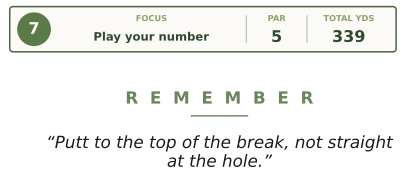
Unlike a book that's all numbers and nothing else, every hole also includes a short line of encouragement — a small nudge before the swing, not just a distance to the pin.
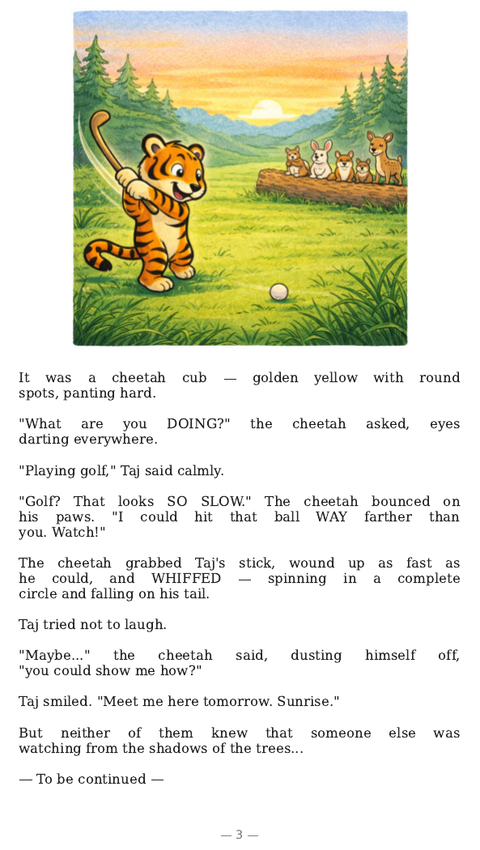
And if your junior is on the younger side, there are also word searches, trivia, and mini-stories to keep them entertained and engaged between holes.
The Reflect Section: Where Mental Resilience is Built
Here's what most yardage books get wrong: they treat the round as purely physical. Hit the shot, record the score, move to the next hole.
That's fine for adults, but juniors are different; they don't come to the green with the mental tools to overcome a bad swing or a missed shot.
JrCaddie's REFLECT section, printed at the end of each hole, asks your junior a few quick questions rated 1 to 5, such as "Did you stay calm after any bad shot on this hole?" or "Did you visualize the shot before swinging?"
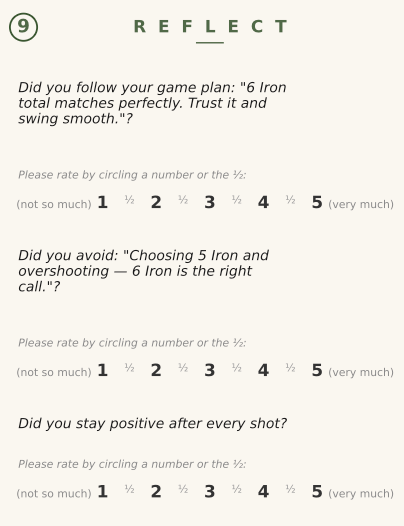
No lecture, no long journaling assignment. Just a circled number and a line for notes before turning the page.
It takes seconds, but it's teaching your junior that the score isn't the be-all and end-all. They're really working on mental resilience and strategy.
Our yardage books reinforce the idea that golf is a long game, not measured by scores. Instead, it's a game of self-awareness, built one hole at a time, and that's a skill that can be used over a lifetime.
The Dashboard: Confidence You Can Actually See
Confidence is hard to talk about with a kid because it's invisible — you can't point to it the way you can point to a scorecard.
JrCaddie's dashboard changes that.
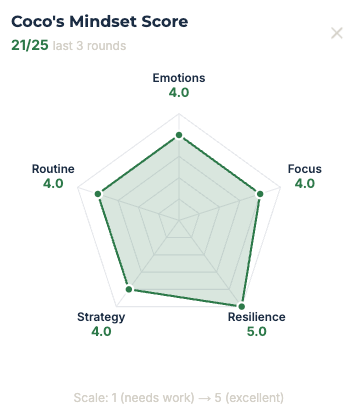
After each round, a junior's REFLECT answers roll up into a Mindset Score across five areas: Emotions, Focus, Routine, Strategy, and Resilience.
Coach Jr., JrCaddie's built-in coaching feature, adds a takeaway after each round — not just "great strategy today," but specific, useful notes like where a junior's short game needs focus or which routine is paying off, such as:
"Sam's fairway accuracy is outstanding at 97%—that's elite-level control off the tee. Keep trusting that swing. Sam has 4 three-putts in just 3 rounds. Focus on lag putting from distance to get closer to the hole in two."
Parents get to see the pattern, not just the score.
They also get access to an Active Training Plan with personalized focus areas and drills that target decision-making, emotional control, reset routines, and more.
If a junior's numbers show they're struggling to stay composed after a bad shot, the plan doesn't just point that out—it gives them a specific drill, like a Confidence Reset Routine (three deep breaths, one positive word, execute the shot) or a Bounce-Back Challenge.
A junior's Resilience number climbing over a season, even during a rough stretch of rounds, is proof of progress that a scorecard alone will never show.
My Bag: Distances That Keep Up With a Growing Kid
A junior's driver distance in March isn't the same as in August.
Most yardage books can't keep up with that — they're printed once and treated as fact throughout the season.
My Bag tracks carry and roll for every club, flags gaps and overlaps in a junior's bag, and — because it's built on actual logged rounds — surfaces distance-change suggestions as a junior's swing evolves.
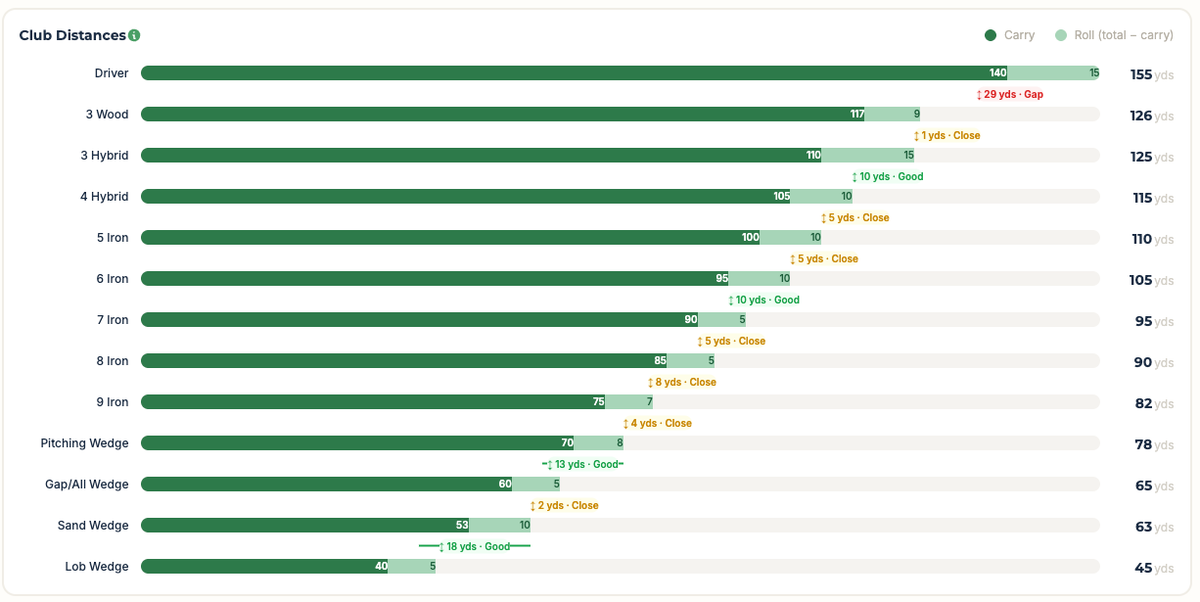
No more guessing whether a 9-year-old still hits their lob wedge 45 yards or whether that number quietly dropped to 30 two months ago.
The Part Nobody Else Is Doing
Plenty of yardage books will tell a junior how far it is to the pin.
Many apps will track scores and stats.
What's much harder to find is a single product that treats the mental game as seriously as the physical game — one that pairs real course data with genuine reflection and turns something as fuzzy as "confidence" into something a parent and a junior can actually watch improve.
That's the gap JrCaddie is designed to fill.
Not a smaller version of what adults use. Not a toy.
A tool built for exactly what junior golf requires — on the course and in the six inches between a junior's ears.